
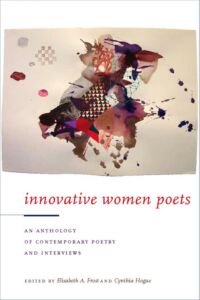
 Frost, Elisabeth A., and Cynthia Hogue, eds. 2006. Innovative Women Poets: An Anthology of Contemporary Poetry and Interviews. University Of Iowa.
There should be a word for that moment when, in the middle of some task, you suddenly look up and freeze in your tracks. Like when you’re driving to a medical appointment and you realize the car is heading toward the office or the grocery store instead. Or, while washing the dishes you pause, suds dripping from your hands, and ask yourself, what am I doing?
This happened to me after writing poetry for 6 years or so. I had been working intuitively, letting my thoughts flow, then polishing the results without engaging in much study or reflection. Sure, I had taken the standard generative workshops and participated in various writing groups but I had never asked myself why I was writing poetry in the first place. Although I had published several chapbooks and some individual poems, I worked blindly, producing one poem after the next with little sense of direction. I began to feel I was repeating myself or, worse, that I was writing for my poetry groups, not responding to existential concerns.
I ignored my malaise for a while, dismissing it as the writer’s equivalent of having a cold or getting up on the wrong side of the bed. Finally, I listened to my instincts. I quit all my writing groups, abstained from conferences and workshops, and kept on writing, trusting the process and temporarily ignoring the results. Crucially, I shared my experience with poet friends.
Things started to turn around in the summer of 2025 over lunch at Manzanita Market in Taos, New Mexico with my mentor and friend, Veronica Golos. A stunning poet and generous teacher, Veronica leads one of the writing groups I had recently exited. Instead of expressing dismay or trying to convince me to stay in the group, she suggested that we read together and talk about poets and poetry. She recommended an anthology of poetry and interviews entitled Innovative Women Poets (University of Iowa 2006). What makes them innovative, Veronica wanted to know, and what does innovation in poetry even mean? Suddenly, a new adventure was underway.
First impressions quickly arose. I noticed that the poets in the anthology differ widely in the fluency of their reflections on the writing process. In fact, I began to suspect that clarity in reflection occurs in inverse proportion to the lucidity of the poems themselves. This hypothesis led to my second observation: innovative women poets are hard to understand (assuming that we ever understand a poem, or that understanding is even an appropriate goal for reading poetry). In other words, the book presented significant challenges and invited sustained consideration.
I set myself the task of evaluating each poet in turn, analyzing her interview remarks and studying her poems. I hoped to discover the meaning of every word in the anthology’s title: innovative; women; poets. What does it mean, I asked myself, to innovate? To be a woman? To be a poet? To be all three at the same time today? I settled in to disciplined study.
For each of the fourteen poets, I wrote a brief analytical essay, then formulated a question that, for me, remained unanswered in the book. The result is the essay that follows and includes these poets.
Poets
Gloria Evangelina Anzaldúa
Mei-mei Berssenbrugge
Jayne Cortez
Rachel Blau DuPlessis
Kathleen Fraser
Alice Fulton
Barbara Guest
Susan Howe
Harryette Mullen
Alice Notley
Alicia Ostriker
Sonia Sanchez
Leslie Scalapino
C. D. Wright
Innovative Women Poets
A reflection on the interviews and poems
in
Innovative Women Poets:
An Anthology of Contemporary Poetry and Interviews (Frost and Hogue 2006).
Gloria Evangelina Anzaldúa
Talking Back
Gloria Evangelina Anzaldúa’s poems speak against environments that mark her as misfit: Anglo culture, patriarchal society, and conventional ideas of femininity. She articulates resistance in multiple voices: the first person in “Cihuatlyotl, Woman Alone,” third person in “Del otro lado,” and a maternal persona in “Don’t Give In, Chicanita.” The range of voices Anzaldúa creates confronts multi-dimensional othering with the power of a multitude. This technique illustrates the section of her interview with AnaLouise Keating concerning her use of “we” and “I” in terms of “speaking with” instead of “speaking for” (25-26). Even when she does not use first person pronouns, her voices of resistance reverberate with a history of repression and the inflections of many speakers.
“Cihuatlyotl, Woman Alone” intensifies this effect by its presentation on the page in a column justified against both margins, simulating restrictive cultural boundaries that provoke resistance. Additional techniques that advance Anzaldúa’s backtalk include gruesome images, such as those of a decapitated woman and wailing in the wind in “Del otro lado” and hints of history interwoven with streaks of hope in “Don’t Give In, Chicanita.”
Anzaldúa speaks at length in her interview about the shamanistic connection she feels to a “spirit world.” With metaphors of sexual intercourse in “Interface” and of eating in “Poets Have Strange Eating Habits,” she imagines bodily orifices as portals for souls and spirits. Her ascription of ontological status to souls and spirits presents a dilemma for me. On one hand, I sympathize with the affirmation of alternative sources of power and modes of existence in the midst of social situations that withhold acceptance and foreclose creative possibilities. Her poems do not require a reader’s acceptance of her mystical metaphysics to appreciate their fantastical images. Anzaldúa’s lyrics evoke sympathy and understanding as powerful imaginative constructions.
On the other hand, Anzaldúa seems to confuse materialism with “objectivity” and knowing with a unique type of “seeing,” thus bending her ontology and epistemology away from verifiable scientific methods. She (falsely, in my view) understands genetics as a kind of determinism and confuses hostile, intentional teaching for the impacts of experience and socialization. Although she claims that everyone possesses the potential to see spirits, her poems articulate an idiosyncratic vision, suggesting only private access to her spirit world. I find it impossible to grant the necessity of rejecting scientific epistemology and materialist ontology in favor of alternative ways of knowing for which no apologetics is offered. Despite these stumbling blocks, her poems communicate with power and her images open vivid worlds of imagination.
- As Anzaldúa’s poems empower resistance, do they also fetishize individual experience?
Mei-mei Berssenbrugge
Linguistic Surface
Mei-mei Berssenbrugge creates poems from what she calls a “map” of words and images that she collects and assembles into physical collages (53-54). Occupying an “outsider” perspective that embraces the fragmentary character of experience and especially women’s experience (49), Berssenbrugge’s poems present a “linguistic surface” that smooths the seams between fragments, representing “the textile of our experience” (53). Consistent with this image, Berssenbrugge employs long lines and sentence syntax that delivers words in complete grammatical units, yet her long lines read like poetry, owing to the space between lines, heightened language, and long successions of images.
Techniques that contribute to Berssenbrugge’s creation of a linguistic surface include features proscribed by the prevailing expectations for contemporary poetics, such as the frequent use of abstractions, adverbs, telling (as opposed to showing), intransitive verbs and the passive voice. The first and last lines of “Chinese Space” offers a case in point:
First there is the gate from the street, then some flowers inside the wall,
then the inner, roofed gate. It is a very plain wall, without expressionistic means,
such as contrasting light on paving stones inside the courtyard to the
calligraphed foundation stones.
…
This is so, because human memory as a part of unfinished nature is provided
for the experience of your unfinished existence.
Pronouns usually occur without antecedents, so the poem’s actors remain anonymous.
Besides departing from conventional wisdom about effective poetic speech, Berssenbrugge’s poems cohere by contradicting standard formalist canons. Her collaged linguistic surface defies perceptions of structure in favor of simple concatenation. Even in poems comprising numbered sections, such as “Empathy,” “I Love Morning,” and “Honey,” boundaries between sections remain soft, with subtle changes of scene or subject. Her abstract language places readers at a distance, creating an airy, global perspective. Berssenbrugge overturns the formalist reliance on irony and tension to unify a poem. Even when she specifically mentions tension, as in “Empathy,” her long lines and frequent use of the passive voice gentle the conflict between its male and female subjects. The poem ends with a reference to the reader’s “unfinished existence,” not to its narrative actors.
In her conversation with Laura Hinton, Berssenbrugge names as important influences her experiences with Georgia O’Keefe and Agnes Martin in the northern New Mexico landscape (48). Readers do not need to know this background to experience and appreciate her poetry but Berssenbrugge’s sensibilities correspond strikingly with these visual influences. Her meandering sentences echo the vast horizon of the Taos plateau and Martin’s fascination with horizontal line. Berssenbrugge’s collaged, linguistic surfaces evoke O’Keefe’s subtle colors and Martin’s preference for generalized emotion over specific thoughts and ideas.
Berssenbrugge tells Hinton, “I don’t think artists are happy with the world and they feel a need to make another world” (55). For me, Berssenbrugge’s world-creation project succeeds. I leave her poems with a sense of a spreading horizon that encompasses more than any viewer can take in. Her poem-worlds attend more to their contents than to their boundaries. Consistent with her notion of “unfinished nature,” (“Chinese Space”), disparate elements are juxtaposed but without any sense of disjuncture, placing each component against a backdrop large enough to diminish its scale.
- What do Berssenbrugge’s poems say to the reader, or is the point not to convey a particular message but rather to relativize experience against an expansive landscape?
Jayne Cortez
Languages of Art
Throbbing with musics of Black experience, Jayne Cortez’s poems explode with color, motion, and often violent imagery. She relies on repetition to evoke musical rhythm but music’s influence extends beyond structure in Cortez’s poetry. For Cortez, music and other modes of artistic expression furnish vocabularies of passion and cultural reference. Using languages of the arts, Cortez explores the inextricability of brutality and pain from human experience. Her poems integrate sound, movement, image, and semantics in powerful expressions of meaning.
While “Bumblebee, You Saw Big Mama” simulates song, “So Many Feathers” conjures dance in a mesmerizing performance organized by repetitions with enough variation to create the impression of movement patterns. “If the Drum Is a Woman” exhibits a sophisticated musical sensibility, chronicling in terms of violent abuse a music gone wrong, whereas “About Flyin’ Home” depicts ways that music, variously performed, can transport both performer and listener. “States of Motion” details another kind of artistic transportation, naming each in a long list of artists who are carried away in or by means of their art.
Shifting to the inspiration of visual art, “Lynch Fragment 2” speaks in the persona of a metal sculpture created by Cortez’s spouse, Melvin Edwards. While her other poems use words and idioms in dialect, “Lynch Fragment 2” bends syntax itself to the breaking point with ungrammatical phrases, beginning with its opening couplet: I am bleed mouth nod/from an oath in sorrow. Its twisted phrases mirror the sculpture’s molded metal pieces.
“Rape” describes a war on women’s bodies, selves, and lives, chanting a rhetorical question to an unfeeling world: what the fuck else were we supposed to do. Its multiple protagonists represent the pervasiveness of sexual assault and its grotesque images justify the fury the poem describes.
- What do the departures of named artists in “States of Motion” imply about art? Does the poem suggest that art is bereft by their leaving, or that the retreat of great artists represents a kind of ascension due to the quality of their work? Does the poem simply describe the changing nature of artistic expression or does it suggest some other interpretation?
Rachel Blau DuPlessis
The Drive toward Change
I made a vow to cultural critique with the rise of feminism. I have kept that vow in a number of genres and modes (109). So states Rachel Blau DuPlessis in her interview with Jeanne Heuving. As a poet-critic in the Objectivist mode of Louis Zukofsky and George Oppen, her writing aims to remake culture by means of literature; it produces works that wield power to shape society. As a feminist writer, DuPlessis finds kinship with the programs of early modernist poets such as Dorothy Richardson, Gertrude Stein, and Virginia Woolf to both “de-track culture …and to make something completely different” (98). DuPlessis sees these two commitments, to feminism and to Objectivist stylistics, as influences in tension (107). As a feminist, DuPlessis affirms women’s writing as a means to register voices otherwise absent, repressed, or distorted. Still, she aspires to more than mere expression. In whatever genre or mode, an ethical imperative to alter modes of thought drives her writing.
Her drive toward change requires DuPlessis to stretch, revise, or remake literary genres. In poetry, she responds to what she views as the “formal and ideological inadequacy of lyric” by engaging in a “gendered critique” of that genre, which, in her view, positions females as characters in someone else’s lyric but never their own (97). Moreover, she rejects “poems centered only in the private world” (98). DuPlessis takes care not to reject lyric outright but to resist it; “to surround it, to build through it, and to rupture it—to break it up inside to become something else” (98). Because women’s experience is “fragmented and serial,” (96), the “I” of the poem, she claims, is already also “fragmented and fissured….It doesn’t seek wholeness, healing, or other ideologies of closure” (97). The structures of DuPlessis’s poems, therefore, innovate beyond conventional forms.
DuPlessis employs various techniques to rupture and transform lyric. The serial poem responds to the lack of closure that women’s experience characteristically entails. In her serial poem “Writing,” every section begins with a period, signifying that the poem emerges only after conventional expressions end. “Writing” serves as the “portal poem” (a borrowed phrase from Ron Silliman) for “Drafts,” serial poems that constitute the bulk of her body of work in poetry. Consistent with her Objectivist sensibilities, DuPlessis envisions each poem as a “donor draft” for the next, forming “a topology of mutuality.” Based on Gertrude Stein’s imperative to “begin again,” DuPlessis employs the technique of “fold” in poetry, whereby poems use repetition and especially the repetition of sounds to continually fold over each other. The poems that comprise “Drafts” are autonomous but linked; each poem generates new poems, functioning as “muses for each other” (98-99).
Drawing on her Jewish background, DuPlessis understands midrash as a metaphor for poetry. She writes a poems as “a self-gloss mechanism” (100-101), implying her rejection of the final word, the definitive statement. Each assertion necessarily calls forth another. “Writing” contains handwritten lines on the printed page that read as glosses, commentary, and dialogue. The fifth section of “Draft 27: Athwart” challenges the task of written quotation because the poem does not specify the order in which its segments should be read. Its lines are divided by long spaces and the segments on the right sides of the spaces seem to connect with each other, rather than to the segments on the left sides. The rightmost lines can be read continuously, as midrash.
In the poems selected and excerpted for the anthology, “Crowbar” elevates rhyme and rhythm above semantics, suggesting the influence of the Language writers DuPlessis admires (109). “Draft 27: Athwart” also exhibits this feature:
Untranslatable it
is the transverse torque
across this course.
The poem’s fourth section extends an objectivist sensibility to another art form, music:
Within the concert of the known
an errant sort
gets thrown, whereupon
largo twists itself
into capriciousness.
…
The lapse looms large adrift
belongside what should have
been unquestionable song.
Its cumbersome shadow
blots a round of Mozart.
Here DuPlessis conceives of music, like a poem, as an object. Her poem incorporates lines from other authors, as does “Draft 52: Midrash.”
Three moments in Heuving’s interview with DuPlessis stand out for me. First, I sympathize with DuPlessis’s rejection of lyric on the grounds of its situation solely in private space. Although I think lyric need not ignore social and cultural dimensions of experience, it often does. I think it is fair to say that the form tempts writers into the private realm. I share DuPlessis’s commitment to move beyond private experience to provoke cultural change.
Second, her statement of self-critique fascinates me: “Until I realized my own kind of feminist project, I didn’t understand the poems I had been writing. I could not read myself” (103). For me, this judgment implies an ethic of authenticity. I appreciate her honesty, since I, too, find it difficult to comprehend her poetry. In fact, it is not so much that her poems seem hard to understand but that, for me, they challenge the very act and process of reading and understanding. Nevertheless, I admire a poet who writes what she must write, even if it seems incomprehensible, even to herself.
Finally, I feel inspired by DuPlessis’s view of herself and women writers in her time as contemporaries of the early modernists and subsequent feminist writers of the twentieth century (108). I take comfort in her sense that, because the “heroic” work of the early modernists such as Gertrude Stein and Virginia Woolf did not have its proper impact in its own day, today’s feminist writers therefore keep company with those watershed figures, despite the passage of time. As disheartening as it is to realize that the feminist project has advanced so little in one hundred years, I find it energizing to think that writers today can still participate in the feminist projects of Stein and Woolf.
While I share with enthusiasm her ethical commitment to literature and many of her interests and sensibilities, I struggle while reading DuPlessis’s poetry. I do not yet experience the power of her poems as objects that can change the world. At the same time, I appreciate her conviction that writing can and must respond to the needs of the age, even if that means bending its form and syntax beyond immediate comprehension. Her writing and especially her reflections on writing command my respect.
- How far can poems go beyond the boundaries of convention before they surrender their power as vehicles of communication and cultural influence? Can this question be answered only after the passage of time? Does the answer depend on a reader’s preparation or does boundary-breaking always limit a poem’s effectiveness?
Alice Fulton
The Poet of Barely
In her interview with Cristanne Miller, Alice Fulton claims to innovate in specific ways, yet both her interview and the poems anthologized in Innovative Women Poets barely innovate. Much is made of Fulton’s “bride sign,” a punctuation mark she invented, consisting of two equal signs (==). But as used in “= =,” “Fuzzy Feelings,” “The Permeable Past Tense of Feel,” and the excerpt from “Give: A Sequence Reimagining Daphne and Apollo,” Fulton’s idiosyncratic punctuation contributes little except distraction. Fulton identifies a set of emotions she thinks have been “frozen out” of poetry: newness, the uncanny, slaughter, inconvenient knowledge, and cruelty (134). But contemporary poetry bursts with examples of such emotions. Fulton’s fault-finding with what she takes to be prevailing standards for poetry attacks straw men that, in my view, do not fairly represent contemporary poetry.
Fulton’s comments on craft in her interview present few new insights. She expresses interest in “betweenness” because “it is non-binary” (124). By “betweenness” Fulton seems to mean the liminal space between categories. But contemporary poetry richly explores such marginality in its various forms. Fulton cites her interest in “betweenness” as the reason she often avoids gendered pronouns and words that designate race or class. But one wonders whether her “betweenness” in fact camouflages a flight from being white and female in an elite social stratum (125-26). A similar aspiration emerges in Fulton’s discussion of her desire to “replace boundary with fusion” (136), yet later she admits the necessity of boundaries. She asserts that boundaries are generally seen as “negative” (137), a highly debatable point of view, since women’s writing often applauds and implicitly prescribes the establishment and maintenance of boundaries to ensure a woman’s protection. Perhaps her notion of “texture” better reveals her underlying concerns. “Fuzzy Feelings” contains a definition of texture as an “overall” quality that leaves traces and includes imperfection. Her poem imaginatively captures that breadth of view.
Fulton decries what she takes to be the “mainstream” view of lyric as “humorless,” “voice-based” poetry “where the poet is speaking.” She denounces “lyric-narrative with autobiographical anecdotes [that foster] the traditional range of emotions … [including] loss, desire, mourning, grief, love.” Fulton stops short of rejecting lyric while embracing “the powers of language, language as structure,” seeing herself as “Neither-nor” (128). Yet again, Fulton by no means stands alone in this critique of the lyric form. Many contemporary poets push against traditional boundaries of lyric and explore wider possibilities of language. Rachel Blau DuPlessis (above) comes to mind.
Later in the interview, Fulton argues against her own assertion that it is the poet who speaks in so-called voice-based lyric. She claims that lyrical narratives are typically biographical. In her explication of “Fuzzy Feelings,” Fulton affirms and defends the freedom to invent narrative in lyric poetry. But later she equivocates by stating that inventing something like her niece’s death, to which she refers in the poem, would amount to a lie (135-36), as if a poem must correspond to the poet’s actual life experience. Fulton’s discussion of the lyric genre collapses the speaker(s) of a poem into the poet, erasing crucial distinctions between poet and speaker and between fiction and lies.
Fulton engages in a problematic exposition of lineation in her interview, in concert with her essay on the topic, anthologized in A Broken Thing: Poets on the Line (2011). First, she makes the unsupported claim that “…the line in American poetry has become very arbitrary” and “has devolved into prose,” declaring, “The usual way for poets in the English tradition to lineate is to end the line where there is a pause in the grammatical, syntactical structure of the sentence” (128). Besides erasing the basic distinction between grammar and syntax, her statements ignore the various evocative ways contemporary poets handle lineation. Fulton articulates her preference for the “deckle edge,” meaning line breaks that follow “function words” instead of nouns or verbs that carry comparatively heavier semantic loads (128-30) but I count a mere ten instances of such line breaks in the twelve pages of her poetry anthologized in this volume. Fulton also highlights her use of “syntactic doubling,” whereby a line ends after a word that can be construed to connect differently to preceding words and the subsequent line (128). Neither of these techniques makes Fulton’s poetry innovative or distinctive, since both techniques are widely attested in contemporary poetry.
Fulton’s conversation with Miller includes several generalizations that I read as judgmental and unsubstantiated. Regarding “mainstream” lyric, Fulton remarks that, because her students tend to lineate at grammatical boundaries, their mode of lineation “isn’t a position arrived at after long thought” (129), a conclusion I interpret as dismissive and uncomplimentary to her students.
Concerning reader sensibilities, Fulton asserts, “…I think the prevailing critical wish in U.S. poetry is for a quiet, transparent poetics” (131). Fulton offers no evidence or examples to support this view that derides her readers. Referring to the human consumption of animal flesh, she writes, “eating meat is a form of sadism practiced by people who never think of themselves as cruel” (134). Her statement ignores the fact that humans have evolved biologically to be omnivorous and that individuals have widely various reasons for eating meat. As a vegetarian myself, I sympathize with Fulton’s apparent abstinence from meat but I cannot agree that all human carnivores harbor a sadistic mentality.
Fulton’s poetry encompasses multiple modes and voices, well-illustrated by “Give: A Sequence Reimagining Daphne and Apollo.” She explores a wide range of emotion, as in “The Permeable Past Tense of Feel” and “Fuzzy Feelings.” She voices a notable concern for animal welfare (125, 134-35), demonstrated by “The Permeable Past Tense of Feel,” a poem with an evocative title and wide-ranging imagery. Quick to deride her readers and poet colleagues, Fulton exhibits a narrower oeuvre than she claims, while imprecision, inaccuracy, and equivocation mar her discussion of craft. Fulton barely innovates, even though she offers readable, worthy lyrics.
- Fulton’s poem “= =” defines new punctuation. How does the “bride sign” expand or innovate the functions of poetic speech?
Susan Howe
The Poems of a Painter
Susan Howe manipulates words as images (160). Trained as a painter at the Boston Museum School of Fine Arts, her visual and verbal art both employ collage and quotation (157). Six of the sections in her anthologized poem rely on collaged lines on the page. This exhibits her writing process whereby she types, then cuts lines apart and arranges them on the page like shapes on a canvas (161).
Among painters, Howe mentions Agnes Martin, John Cage, and Ellsworth Kelly, among others, as influential figures (157-58, 164). Howe explains that Agnes Martin’s work facilitated her shift from painting to poetry because Howe finds Martin’s paintings “spare and infinitely suggestive at the same time” (160). The excerpts from “The Nonconformist’s Memorial” anthologized in Innovative Women Poets exhibit a kindred style of minimalism through short lines and stanzas and the absence of punctuation:
Contempt of the world
and contentedness
Lilies at this season
other similitudes
Felicities of life
Among writers, Howe names Charles Olson, James Joyce, Virginia Woolf, and Emily Dickinson as important influences (164). Her influences disclose an interest in absence and silence, alongside a commitment to the artist’s freedom of expression.
Driven by the acoustic power of words (161, 168), Howe understands her poet role as “a calling” that entails an “ethical obligation” (166, 173). Her discussion of manual handwriting sustains this implication by claiming that the “eye-hand connection” implies that the hand gets direction from somewhere, as if such direction originates from an external source (173). Howe’s anthologized poems revolve around biblical material, especially the prologues to the fourth gospel and to 1 John, passages that impute a sacred quality to the word and a preeminence of word over being.
Howe’s meditations on the fourth gospel’s twentieth chapter also evince her interest in absence, since the poems reflect on the narrative of a post-resurrection Jesus who belongs neither to the material world nor to the heavenly realm, yet is seen by a woman. Howe emphasizes both the element of absence and the female-centric quality of this story.
Howe treats biblical materials as if they had all sprung from a single author, collapsing their variety and suggesting a unity they do not exhibit. I struggle to appreciate this approach to the bible, yet I admire her clean style.
- What reading strategy(-ies) is (are) appropriate to Susan Howe’s poetry, especially when her lines are not arranged sequentially on the page? Do their lines refer to each other, to biblical stories, to individual feelings, or to universal experience? What do her poems imply about the referential dimension of language?
Harryette Mullen
Slave Sound Rising
Immersed in the slave narratives she studied for her dissertation, Harryette Mullen invites sung and spoken sounds to reorganize a narrative of experience. Her poems both quote and transform idioms and tropes from many cultural registers to trigger fresh associations. Both her prose poems and her lineated poetry echo and modify cadences of song, hip hop, and dialect, as well as heightened speech forms. Her poetry produces a music that disrupts conventional usages, allowing a varied landscape of black experience to emerge.
Mullen’s resources range widely, from ancient and classical literature to contemporary dialects. From “Muse and Drudge”:
divine sunrises
Osiris’s irises
his splendid mistress
is his sis Isis
creole cocoa loca
crayon gumbo boca
crayfish Crayola
jumbo mocha-cola
Her virtuosic command of language sounds endows her poetry with an improvisational feeling that seems effortless.
Mullen’s prose poetry depends on repetition and speech rhythms to segment her lines. From “Trimmings”:
Clip, screw, or pierce. Take your pick. Friend or doctor, needle or gun. A dab of alco-
hol pats that little hurt hole. Hardly a dimple is soon forgotten brief sting.
In her lineated poetry, rhyme plays a more prominent role, especially end rhyme, although her rhyme sequences remain loose and avoid rigidity. From “Muse and Drudge”:
stop running from the gift
slow down to catch up with it
knots mend the string quilt
of kente stripped when kin split
….
Ethiopian breakdown
underbelly tussle
lose the facts just keep the hustle
leave your fine-tooth comb at home
…
she gets to the getting place
without or with him
must I holler when
you’re giving me rhythm
Mullen’s lineated and non-lineated forms trigger associations through pun and juxtaposition rather than through logic or theme. Her lines and stanzas cohere more through sound than semantic meaning. “Muse and Drudge,” for example, combines Sapphire’s lyre, my last nerve, a tub of gin, honey jars of hair, yellow mattress, avid diva, a weak-kneed scarecrow, double dutch darky, your embouchure, jumbo mocha-cola, orange juice execution, and spilled milk. Some passages treat language itself, both spoken and written. From “Trimmings”:
Thinking thought to be a body wearing language as clothing or language a body of
thought which is a soul or body the clothing of a soul, she is veiled in silence.
And from “S*PeRM**K*T”:
Lines assemble gutter and margin. Outside and in, they straighten a place. Orga-
nize a stand. Shelve space. Square footage. Align your list or listlessness.
Mullen’s poems register experience from the underside: black, female, oppressed. By juxtaposing words and idioms from the dominant culture with those from subaltern cultures, Mullen disrupts and distorts conventional meanings that serve the interests of prevailing power. Her sensitive ear creates a new music and makes space for restricted voices.
- Mullen uses language in a way designed “to create an audience” and “to invite more readers” (204), even setting some of her poems to music (206). Does her mode of language relativize semantics and the pursuit of meaning?
Alice Notley
Timeless Time
Disturbed by a time that threatens to end time, Alice Notley writes from a threatened planet rimmed round by war. Born in the last year of World War II, Notley lived to see France, then the US. resume bloody struggles in Viet Nam and southeast Asia. Meanwhile, she watched as worldwide calls to save the planet in the 60’s and 70’s fell on deaf ears. Her poems speak the rage and frustration of such violence, for which she holds the whole of humankind to account, knowing it’s too late to find an answer. Her words ring out from a time when Nixon, Viet Nam, and the dark side of U.S. drug culture were the worst that could be imagined. Now her despair seems more harbinger than trumpet, since Notley lived to see disaster grow more pervasive and lethal than in the Viet Nam years and their aftermath.
Notley situates Désamère in the desert as pre-apocalypse, around campfires conducive to shamanistic voices, and in dreamspace. The excerpts from “Désamère” in the anthology use dialogue to migrate through these real and imagined spaces while coming to terms with the horrors of the day. The poem creates a time out of time at a campfire in a desert with talk of dreams that interpenetrate the past and future: Approach a desert then, in a prophecy/An America now and later. Her characters’ speech reverberates through time. I dropped the shell, states a prophetic visitor, with its multiple implications.
‘You’re both caught in times separate
From your condition now,’ he says
‘Still causing it, you can’t leave your pasts
I’ll try to dream you out of them.’
The speaker is ambiguous in the dialogue: ‘When you die, I take it hard,’ scrambling past, present and future time.
Notley is often associated with the second generation of the New York School of poets and “Désamère” exhibits the ethical and political concern associated with that school. Still, the classification perhaps lends more weight to her associations than to her own unique voice. Formally, her work is more often associated with epic than lyric, acknowledging the wide sweep of her vision and the narrative structure of her reflections. She turns to dreaming, the natural world, and to the craft of poetry itself for hope and healing.
‘I dream now, ’Desnos says, ‘that same flower
Has tongues for petals which move and quiver
Out of its center a language comes
Indecipherable, melodic….’
Her character concludes these words:
A poet may be a good saint because
He or she hears the word—the language
Spoken by the flower—and can repeat it.
- How successful is Notley’s desert-dreamscape as a container for her political concern? Does it offer readers a retreat from the world’s violence or a space to find an ethical path?
Alicia Ostriker
The Bible, Revised Version
Drawing on narrative and prophetic traditions in the Hebrew bible, Alicia Ostriker steps into the poetic arena as a latter-day Moses or Job, daring to argue with god and rewrite the rules. From the rabbinic tradition, she uses midrash like the sustain pedal on a piano to perpetuate sound, enabling her to continue conversation. She employs hybridized forms such as collage, emulating Adrienne Rich and others, as “a way of incorporating silence into the poem. You leave gaps. You create spaces for the reader to jump into which brings the reader into more of a transaction with the poem.”
Ostriker employs musical technique to range across biblical and political themes. In “The Eighth and Thirteenth” she describes musical sounds in terms of the violence her poem addresses:
…The composer
Draws out the minor thirds, the brass
Tumbles overhead like virgin logs
Felled from their forest, washing downriver,
And the rivermen at song. Like ravens
Who know when meat is in the offing,
Oboes form a ring. An avalanche
Of iron violins. …
In “About Time,” Ostriker employs music differently, using rhythm and rhyme to build a sense of urgency:
The work of science. Of art.
The philosophical heart
Hardened. Timeless. If you strike it, it clangs. It
Beats time.
An ambitious series poem, “The Volcano and the Covenant” reverberates with biblical themes, political references, physical images and descriptions of emotion, ending with a meditation on ruach, the Hebrew word for breath, wind, and life. I do have a heavy burden, she writes, and cannot wait to put it down.
- What conclusions can be drawn from Ostriker’s renovations of language, traditional texts, and sound? Do her biblical references pull the reader toward conventional or unconventional interpretations?
Sonia Sanchez
All that Jazz
“I heard the music at the base of my [the] skull” (279, 284), Sonia Sanchez confesses, in response to a question about how she blends jazz with her poetry. Sanchez’s interview with Sascha Feinstein exhibits a personality fully consistent with the jazz poetry Sanchez writes. Her discourse flows in narrative, not expository, form and her story plots follow musical themes and relate musical anecdotes. Although Sanchez claims a primarily verbal orientation and narrates the long road she traveled before she was enabled to perform poetry with music, even her prose speech reverberates with the musical influences that shaped her writing.
The poems anthologized in Innovative Woman Poets illustrate the comprehensive interpenetration of poetry and music, to the point that the silent, printed poems seem all but incomprehensible. As a reader, I can imagine stunning performances of “a/Coltrane/poem,” “Blues,” “Sister’s Voice,” and “A Poem for Ella Fitzgerald” but their expressive dimensions remain mostly implicit in printed form. The poems employ the fundamental auditory techniques of rhyme and repetition to create rhythm, mood, and structure. Still, as a reader I would need the three-dimensional performance to intuit her topics and meanings. By contrast, Jayne Cortez’s poetry, which Sanchez cites as a good example of the kind of poetry she writes, incorporates musical techniques and sensibilities in a manner comprehensible in silent print. Unlike Alicia Ostriker who describes musical sounds using images from the natural world, Sanchez remains content to utter the sounds themselves and to let them stand alone.
- What does Sanchez’s writing imply about the publication of poetry? Does her poetry make the case that the print medium falls short of poetry’s expressive possibilities? Are her poems innovations or are they more accurately received as revivals of poetry’s ancient connection with song and sound?
Leslie Scalapino
Series and Surface
Reading Leslie Scalapino’s “as-leg” made me wonder why, among the literary influences she names, Emily Dickinson was missing. Dashes punctuate Scalapino’s lines in a similar way, and her stanzas remain brief, allusive, and cryptic. As with Dickinson, Scalapino’s dashes make space within a line, creating breathing room for a reader to think, imagine, and wonder. Her loosely connected stanzas hint at a reportorial voice and an investigative view—nonjudgmental and unfriendly to narrative. Her verses suggest an expansive environment, incomprehensible by human perception.
Scalapino places stanzas on the page at various levels of indentation. The visual effect invites readers to focus each stanza separately rather than to seek connections with preceding or subsequent stanzas. Scalapino’s form conduces to serial writing, since each stanza comprises a self-referential unit. Where connections are explicit, they derive more from repetition than from logical or thematic connections to other stanzas in the poem. Stanzas on pages 320-21, for example, repeat on/in the street. Those on pages 321-22 repeat woman/women, whereas stanzas on pages 322-323 repeat man and blue. Thus Scalapino generates a continuity unpunctuated by emotion or sentimentality.
In her interview, Scalapino denies that her references function as symbols (305). She describes her intention to construct a flat surface, using the serial form. “The idea is to have the writing be almost like a sheet or screen on which things register,” she writes (311). Generating such a surface expresses Scalapino’s desire to depict a Buddhist sense of the self as illusory, and consciousness as vast and incomprehensible. Scalapino bends syntax to support her goal, concatenating words into barely comprehensible utterances. “Crowd and not evening or light” exhibits this effect in its title and includes photographs aimed at constructing a neutral surface: they feature nearly indistinguishable figures against a background of parallel, horizontal lines designating seascape, horizon, and bands of cloud. About this poem she writes, “The terrain is completely flat, and so are the photographs. They give the impression that everything’s flat, that there’s no inside to them. …I also wanted the photos to be a nonverbal surface that cannot be separated from the writing” (315).
I sympathize with Scalapino’s worldview and I sense from her poem a quiet spreading of awareness consistent with such sensibilities. While I acknowledge her effort to deny that an inside need always be distinguished from an outside, I question the extent to which any writing can achieve the flatness she seeks, since words always trigger associations. Similarly, I do not understand how writing can aspire to be non-symbolic, since metaphor is fundamental to language, and symbol to meaning-making. I experience her poems as a broad, calm space in which to wander—no small achievement. Still, I struggle to make meaning from her interview comments and poetic lines.
- Scalapino’s visual poetry incorporates lines and images, whereas Susan Howe’s uses words as images. Do these examples constitute a visual vocabulary? Does poetry require semantic meaning to achieve its expressive ends?
C. D. Wright
Risk Everything on the Page
C. D. Wright claims the writing surface as a place of trust (341). She expresses sureity about little else besides “Who I am,” a woman interested in justice, beauty, humor, idiom, and “cultural specificity” (333-34). In her interview, Wright confesses that she doesn’t “have a strong enough sense of lineation” (332). Perhaps this accounts for her near-prose style in “Deepstep Come Shining.”
The stanzas excerpted for this anthology exhibit Wright’s interest in idiom. Her poems appear on the page like prose paragraphs but they deviate from prosodic convention. Wright often uses incomplete sentences and concatenates many speech registers and turns of phrase. For example, she writes(343):
…Whatever the
swamp doctor says. Comply. Whether a believer or not.
Remember Pascal shewed our very air has weight. It can be
measured.
The passage moves in and out of colloquial style while mentioning Pascal and using the archaic shewed. In another illustration, Wright combines idiomatic and elevated vocabulary with invented words (348):
…Worry over
maundering. Hunger over worry. Tranquilized with a private
jukebox in formicalight. Endless refills. Pigs-in-the-blanket-
and grits-on-the-side-time. Beats the bejesus out of Bertha’s
conditioned-and-caffeinated love.
Wright notes Mei-mei Berssennbrugge’s influence on her writing, and it is easy to see how Wright achieves similar effects by juxtaposing disparate references in a long poetic series, even though the two poets’ aims differ. Wright relies on her nearly unlineated style to connect and unify apparently unconnected utterances. For example, she writes (344):
There are enough signs. Of the lack of tenderness in the
world. And yet. And yet. All you have to do is ask. Anyone
here can extol the virtues of an onion.
Her prose-like form invites her readers to find the connections and construct the story. Although she invents new ways of making meaning, her poems resonate with Wright’s voice of authority. The first and final stanzas excerpted in this anthology conclude with the declaration, I was there. I know (342, 349).
- What defines the nearly unlineated “Deepstep Come Shining” as poetry? How does Wright’s treatment of the line work differently from prose?
Barbara Guest and Kathleen Fraser
Flights from and toward Reality
Both associated with the New York School and its art scene, Barbara Guest and Kathleen Fraser were friends who also influenced each other’s poetry.
The anthology editors emphasize surrealism as inspiration and the associative leap as a primary characteristic of Guest’s work. Her departure from logic and narrative disrupts the effort to find a through-line in her anthologized poems, yet certain motifs emerge. I notice embrace, pairing, and relationship as connecting strands. “Parachutes, My Love, Could Carry Us Higher” addresses an unnamed you in its route through a suspended stratum of water and air. “An Emphasis Falls on Reality” also addresses you among a series of metaphors involving clouds, snow, morning, silhouettes, silence, shadow, calligraphy, trees, and a house. One image stands out for me: willows are not real trees/they entangle us in looseness. Guest’s us seems caught up in a suspended world. In “The Rose Marble Table,” Guest names her you: it is the Creative soul that hesitates…ignoring the universe, igniting shadows amid rich images relating to water and trees. “Though nothing can bring back the hour” repeats the pairing motif with we waltz, bride and groom, and Let that embrace last on the rim of the inkstand. Like “An Emphasis Falls on Reality” that invokes calligraphy, the inkstand image relates surrealistic flight to the act of writing.
Guest’s shorter poems challenge with their brevity any sense of coherence. Some poems also distance the reader with archaic language. In “Spirit Tree,” Lo, miraculum, Pleaseth, chalice, Swete take the reader away from the present moment, as do turret, documenta, miscellany, and Saints in “Turret” and Longinus, Leviticus, Leibnitz, and calico in “Petticoat.” “Noisetone” depicts sound as color. Guest’s fantastical flights conjure alternative realities that shift a reader’s perception of the phenomenal world.
Kathleen Fraser’s poems exhibit similar characteristics: the unnamed you in “Norchia,” archaic language such as thus and doth in “Wing, VI. Crossroads,” and a departure from realism, although Fraser’s flights from reality center more on the surrealism of dreams than magic. Like Guest, she registers a fascination with writing in “Norchia,” seeing ancient Etruscan script as a mysterious mode of communication, suggesting a connection with her own writing. Like Rachel Blau DuPlessis, Fraser includes handwriting in her poems when she uses the Greek word, αγγελος.
Distinctive features include prominent references to the cube in “Wing, II. First Black Quartet: Via Tasso” and “Wing, III. Wing: Via Vanvitelli” and an interest in palimpsest, suggested in “Wing, I. The Underdrawings” (leaving traces of decision and little tasks performed/as if each dream or occasion of pain had tried to lift itself/entirely away…” and the graphic repetition of partial erase and lift in the figure of a wing in “Wing: X. Vanishing Point: Third Black Quartet.” “Wing, II. First Black Quartet” also depends on a graphic arrangement of words on the page. The section of “Norchia” that begins, Dear Susan is unlineated and its syntax is indistinguishable from prose.
Both Guest’s and Fraser’s work notably leave logic and narrative behind in favor of floating worlds in which the poem’s speaker is suspended in water, air, trees, or clouds. Both poets hint at the importance of written expression, suggesting self-reference to their poetry. Neither poet retreats into solipsism but both retain connections to you, we, and us, even if those partners remain unnamed.
- What guides a reader’s interpretation in poems like those of Guest and Fraser that build surrealistic and disconnected images?
Conclusion
The poems and interviews in Innovative Women Poets invite reflection about the meaning of and motivation for innovation in poetry, especially among women. The poets in this anthology employ a vast array of linguistic registers, images, and graphic elements. Some incorporate handwriting. Many draw inspiration from nonliterary arts, such as music, dance, painting, and photography. Many report a sisterhood with women engaged in similar pursuits.
I think it is fair to say that many if not most of the poets in this anthology innovate because they are female and have experienced poetry primarily as an expression of male experience, or they find women’s experience insufficiently represented or appreciated in established poetic tradition. Many cite modernists—male and female, poets and visual artists—as models, applauding their efforts to break free from rigid poetic structures and forms. Whereas conventional uses of language aim to make sense of the world and to organize experience into comprehensible forms, the poets of this anthology reject the misogynist, patriarchal, colonial, and other oppressive logics that organize and drive such expressions. These innovative women poets use language to depict the fractured quality of women’s experience that does not, in fact, make sense and must not be accepted as sensible in an unjust world.
Many of the poems anthologized in Innovative Women Poets defy comprehension or interpretation, since the poets eschew both established poetic forms and conventional modes of speech. The poems, in other words, are not transparent; they disorient and frustrate the search for meaning, replicating in the reading experience the alienating dimensions of female otherness. Nor does their poetic project end there. These poets share their artistic voices by recruiting readers into their poems’ construction, inviting readers to participate in the search for meaning, both in art and in life. The poems challenge readers to go beyond the task of interpretation and assume roles as co-creators. In claiming and using their voices to craft innovative women’s poetry, these poets cast readers as protagonists, urging them to also become speakers.
Works Cited
Alice Fulton. 2011. “As a Means, Shaped by Its Container.” In A Broken Thing: Poets on the Line, 1st ed. University of Iowa.
Frost, Elisabeth A., and Cynthia Hogue, eds. 2006. Innovative Women Poets: An Anthology of Contemporary Poetry and Interviews. University Of Iowa Press.