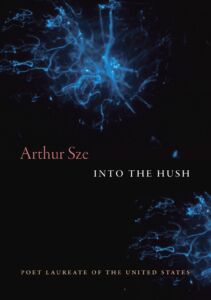
INTO THE HUSH, Arthur Sze, 2025, Copper Canyon Press. PO Box 271, Fort Worden State Park, Port Townsend, WA 98368, https://www.coppercanyonpress.org, 88 pages, $23.00 (paperback).
ISBN-10: 1556597142
ISBN-13: 978-1556597145
When I purchased my signed copy of Into the Hush at Collected Works Bookstore and Coffeehouse
in downtown Santa Fé, I never expected a horror story. Although Arthur Sze, the newly designated
poet laureate of the U.S., often presents images of violence and destruction, he usually situates those
images in a spreading landscape that implies a wide range of experience. This he does with his usual
grace and eloquence in Into the Hush, while employing well-honed techniques, such as numbered
sequences, interleaved writings, strikeouts, unidentified pronouns, and placing colons, commas, and
dashes at the ends of lines and stanzas. Still, Sze’s new poetry collection delivers surprises.
The collection’s first poem, “Anvil,” hints at things to come. Embedded in a list of juxtaposed
images, we read,
when a bartender blows smoke rings and slips through hoops into his past,
…
when the mind, like this Earth is struck and tilts its axis,
…
here is the anvil on which to hammer your days— (3)
As portals of intangible experience, physical images of beauty and violence lead to places of insight, shock, and wonder. Section 4 of the collection’s title sequence concludes,
…and as a skater
gathers speed, I lift off the ice,
not knowing if I will fail
or land, but, in the spin of a leap,
lift in the risk of what we may become,
and find a daylight inside of day. (32)
Such images suggest the multivalence of the book’s title. Into the Hush transports readers to a meditative place on the brink of silence. From that place, we see a spark.
The journey begins with Sze’s clean observations that sparkle with specificity: not just “mushrooms” but russulas, amanitas, clitocybes and … red-capped boletes (“Anvil,” 3); not merely “dying languages” but Bering Aleut, Juma, Tuscarora (“Anvil,” 3), and Klallam (“Spring View 4,” 8). Not simply “species going extinct” but pangolins (“Dilemma,” 17) and least vermillion flycatcher (“Vectors,” 21). And the sparks are
spectacular. Sze frequently invokes the notion of ignition: saguaros in a canyon explode into flames (“Spring View 7,” 11); flames rise in an apartment complex, and alarms sound (“Drought,” 26); we came here/to ignite behind our eyelids (“Río Chamita,” 37); in twilight we sway and surge into flame (“Papyrus Pantoum,” 29); Will he detonate? … when do a child’s dreams ignite? (“3 Forage,” 46); time detonates inside of
time (“6 Wildfire Season,” 49); they stack elephant tusks in a pyramid and set them on fire— (“Fugitive,” 60).
Between the journey and the spark, Sze pauses in the hush, which can take the form of wonder or questioning but its primary form seems to be writing, or language itself, depicted most vividly in the untitled zuihitsu interleaved throughout the collection. Each of its seven segments begins with an image from the natural world, including a hint of human habitation, followed by a single calligraphic gesture performed by two calligraphers working in tandem. It begins,
Whoo, whoo. An owl in the tallest blue spruce. Before sunrise. Patches of ice
in the driveway.
Facing each other, we held a single brush in the air with our right hands.
I, left-handed, felt awkward holding it, but, holding it higher up, he
beckoned me to start. (4)
Human traces progressively enlarge in successive segments, beginning with the faint implication of humanity in driveway. The second segment mentions a piano melody and microspikes under my shoes (14), then a glassed-in hallway and [b]lue bottles on branches in the next segment (20), until the final segment foregrounds human action, hiking a trail along the Nāpali Coast. There, the human gesture blends with the speaker’s calligraphic writing: our bodies, brushes (53). With breathtaking economy, Sze’s zuihitsu implies a fabric of opposing tensions—human actors in their environment, two writers who both resist and assist each other’s writing, and writing in the troubled context of a wounded world, a world wounded by humanity.
The collection is not content to simply aggregate compelling images. The pressure of the human- nonhuman connection, these carbonized/griefs and hungers (“Dawn Branches,”25), builds steadily throughout the collection. In “Swimming Laps,” the speaker observes, with each scissors kick, I know time’s shears (40). In the final poem, “Pe‘ahi Light,” the second segment of its numbered sequence
asks,
…you pause
at desiccated geckos caught between a screen
and a windowpane. Are we ensnared
by hazards we cannot comprehend? (63)
This mounting pressure brings us to the horror story. The scary music begins in “Spring View,” Sze’s first numbered sequence, where in segment 7, images of death, fire, an oil slick and a melting iceberg surround the poem’s warning:
it is time to stop tightening the noose
of shrinking habitat around a roaming jaguar (11)
Soon, the jaguar speaks, or sings. “Jaguar Song” (18) follows Sze’s invented song form, which also appears in “Eraser Song” (24) in this collection and in “Lichen Song” and “Salt Song” in Sight Lines (2019, 29, 37) . These song poems happen in block form between right- and left-justified edges, with lines suggested by embedded spaces instead of punctuation. “Jaguar Song” establishes a relentless pace with mounting tension. Far from voicing a plaintive lyric or emotional soliloquy, the jaguar directly addresses the reader. The poem begins with an em dash, suggesting a fraught, unspoken prologue:
—Just after you sign and envision building homes on this tract you smell me in the dark
know that I move through this terrain at night ….
The poem tracks both human progress and the jaguar’s prowl, making them converge in a nearly perfect chiasm, where a sequence of images is repeated in reverse order, focusing on a central point. Echoing its opening phrase, you smell me in the dark, the poem ends,
…I am the
creature who smells your darkest thoughts and as you turn the key in the lock day or
night out of the darkness I spring—
Between these paired images of darkness, the poem accuses the reader: even now you believe you can borrow my spirit by wearing a mask of my face on your face. Then, past the poem’s midpoint, the jaguar reverses the masquerade: … if you destroy my species I will shape-shift and hunt you in your dreams the fingerprints of your hands resemble the black rosettes on my skin and you will not escape…. Similarly, near the poem’s beginning, the jaguar dares the reader, look at me delve into your fears, then near the end the jaguar taunts,
…remember as a child you came up the
steps from the basement and flicking off the light at the top of the stairs feared a hand
about to grasp your shoulder from behind that fear is alive….
The center of the chiasm reveals the jaguar’s central threat:
…I can pounce on a deer and crush its skull and neck with my teeth
you slash and burn in the jungle force the snakes and macaws to retreat you even burn
your own species alive look into my eyes I am your mirror and transformer….
Writing his journey into the hush is Arthur’s Sze’s answer to the horror of contemporary experience and its interlocking tensions in both human and non-built realms. Writing can never resolve those tensions but, in his vision, the creative act of writing is humanity’s fullest expression. As the fifth segment of the collection’s title sequence proclaims,
A woodpecker has drilled holes into a piñon trunk,
and I write into the hush:
…I write along
the curve of an expanding wave that delineates
the shapes of all things.
Enthusiasts of Sze’s body of work will find in his newest collection the now-familiar hallmarks of imagistic juxtaposition and brilliant clarity but also a distinct urgency about the perilous human condition. Sze’s brevity and clean style generate an intensity that builds throughout the book. Into the Hush marvels at the world while disturbing its readers with the imminent dangers that result from
human violence, greed and neglect. Readers will tremble at its haunting beauty.
*First published in American Poetry Review, May/June 2026, vol. 55/no. 3, pages 34–35.