
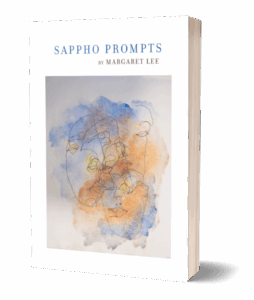
 When a friendly reader of my poems posed the question, “Why Sappho?” I could only offer an inane response: “I have no idea.” I felt utterly at sea while casting about for reasons that might make sense in the digital, polluted twenty-first century with its driverless cars and crypto currency. To me, the answer seemed obvious, yet inexplicable. The modern appeal of a woman’ words composed nearly three millennia ago in a distant land had never arisen for me as a subject requiring explanation.
Typical descriptions of Sappho’s songs note her immersion in the natural world. Sappho not only alludes to her environment but she calls its animals and plants by name. Rarely does she mention flowers generically. Instead, she enumerates the species: roses and yellow sweet clover; dill, chervil, and chickpeas. Not content merely to describe their appearance, she details the setting: the plants are laden with dew or bathed in moonlight. Sappho shows particular affection for violets and the color purple. But these features really don’t explain my fascination with Sappho. Eco-poetry proliferates, not only in our time but among poets through the ages. Surely other characteristics distinguish her voice.
The depth of feeling Sappho expresses provokes frequent comment, especially when she describes what it’s like to be in love, such as in fragment 31 (my translation here and throughout):
…my tongue has been completely shattered;
all at once a thin fire runs under my skin.
My eyes see nothing,
my ears buzz,
sweat pours down, trembling
seizes me all over; more pale than grass
am I, hardly short of dying….
Such sentiments got Sappho into a lot of trouble, since they refer to affection for another woman. (More about that later.) But Sappho also expresses a wide range of emotion, including the joy of shared, youthful memories:
…you will remember,
for we, too, in our youth
did these things,
for they were many, and lovely… (24)
Sappho’s vision is realistic, not romantic. In equally graphic detail, she voices grief over her advancing years. She refers to the trembling of aging skin (21) and bemoans the realities of growing old:
…old age has already my previously tender skin
taken hold, and my dark hair has turned white.
My yearning has been made weighty, my knees do not carry [me];
[knees] which once were light and nimble for dancing, like fawns.
I often sigh and grieve, but what can I do?
It is not possible for mortals not to age…. (58-59)
Still, Sappho refuses to drown in her sorrow. She consoles herself, Someone will remember us, I say, in another time (147). She expresses no fear of death. In fact, she imagines its comforts:
…some yearning holds me in its grip
to die and see the dewy, lotus-covered
banks of Acheron…. (95)
But Sappho’s seductive appeal ranges even more widely. She differs from contemporary voices in her use of prayer. Many of us in the US think of public, Christian prayers in terms of praise offered to a divine father for his power and might. Supplications often beg for the supplicant’s healing or good fortune. By contrast, I find no instances in Sappho of a prayer offered to a god envisioned as male. She usually addresses Aphrodite, the goddess of love and beauty. And instead of shrinking before a god’s overwhelming power, Sappho refers to Aphrodite as a snare-twister and visualizes Aphrodite’s flight from Olympus to the earthly realm in a chariot drawn by swift sparrows swooping over the black earth/with close-beating wings (1)—sparrows, not eagles or horses. Unlike our often vague and insipid visions of heaven, Sappho imagines the presence of the goddess in concrete and specific terms:
…the place where your beautiful, sacred grove
of apple trees stands and your altar
smokes with incense
where the sound of cold water penetrates
the apple tree branches, and roses shade the whole place
and through quivering leaves
delicious sleep drops down,
and in the meadow of horses, blossoms
sprout in the springtime, and
a breeze blowing sweetly…. (2)
Sappho conceives of her prayers as conversations (134), not one-way speeches before a silent god.When she asks questions, she receives answers (1). She prays with more than her own needs in view, frequently entreating on behalf of others. In her prayer for the safe return of a beloved brother who apparently deserves divine wrath for undescribed actions, Sappho begs the goddess to overlook his shortcomings and grant him safe passage (5). In the throes of unrequited love, Sappho even expresses anger at Aphrodite:
…what do you have
in mind, beating me idly like waves in a storm,
loosening the knees with loving desire…? (26)
Sappho addresses the gods with confidence. In a prayer to Hera, wife of Zeus, Sappho dares the goddess to reject her. She reminds Hera of the times Hera answered the prayers of the sons of Atreus, Agamemnon and Menelaus, the commanding generals of the Trojan war. These legendary men, Sappho wryly observes, could pillage, burn, and annihilate the city of Troy but they couldn’t find
their way home without Hera’s help. If Hera, queen of the gods, answered their prayers, Sappho argues, she should certainly grant Sappho’s request (17).
Sappho’s allusion to epic heroes suggests yet another way her songs stand out. She and her audience knew well Homer’s Iliad and Odyssey. (A broad scholarly consensus holds that “Homer” refers to a community of singers, not a single individual, and that the epics came into being over time and under multiple influences.) These tales were told and retold in diverse settings over many centuries and they organized education and culture in antiquity. But Sappho looks down her nose at heroic values. She states her case:
Some a rank of cavalry, others infantry,
still others say ships on the black earth
are the loveliest, but I [say it is]
whomever you love. (16)
Sappho’s songs differ from Homeric conventions in still more ways. The epics employ epithets—stock phrases used to invoke well-known images while meeting the metrical requirements of a poetic line. Sappho, too, employs this device, but her epithets contrast with Homer’s and reflect her island home and female perspective. Her songs take place on the fertile black earth, not on Homer’s violent, wine-dark sea. And instead of perceiving dawn in terms of rosy fingers of light as Homer does, Sappho personifies Dawn as a woman and imagines the sunrise as Dawn’s golden-armed embrace or the trace of her gold-sandaled footsteps. Unlike Homer, Sappho accords the lauded Helen of Troy no special status but compares her with Sappho’s former lover who jilted her. Sappho declares of Helen:
…her husband,
the best of all,
she left behind and went to Troy, sailing,
and neither child nor beloved parents
did she consider at all but was led astray
by love…. (16)
Sappho’s songs exhibit admirable verge. In a severely patriarchal culture, she boldly announces, I wish (22); I yearn and I seek (36) yet demurely insists, but I am not a spiteful person/rather, my insides are quiet (120). Sappho allows herself to spurn her enemies, but the severest curse she levels is that they be carried away by winds and sorrows (37) or, worse, that they be forgotten:
…once you have died, you will lie dead; neither will any memory of you ever
remain, nor longing for you in the future…. (55)
I have referred to Sappho’s “fragments” because her songs survive only in disconnected pieces. Only one complete poem survives. Although new manuscripts of Sappho’s songs continue to be discovered, only about 650 lines survive of the 10,000 lines she is thought to have written. Much of her work was likely destroyed intentionally by (male) authorities of the medieval Christian church.
They found such effusive emotion scandalous, especially when expressed toward other women.
Perhaps this, too, contributes to Sappho’s modern appeal. There’s something about broken pieces that invites us to supply what’s missing. My poems dive into these gaps and connect Sappho’s ancient words with contemporary experience.
_______
Photo By Gotogo – Own work, CC0